OpenGazeLab: An Interactive Toolkit for Gaze Analysis and Event Detection
Abstract
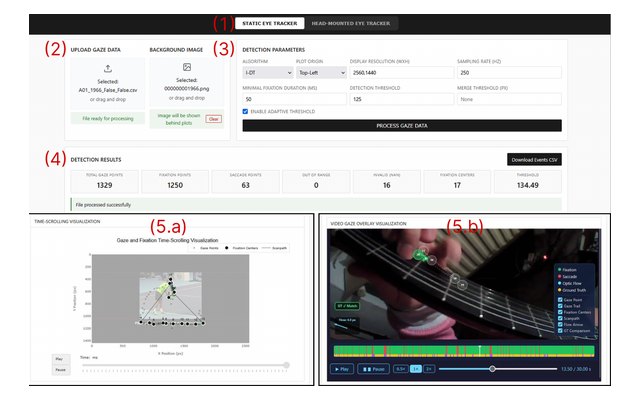
Event detection (e.g., fixations and saccades) is a prerequisite for many eye-tracking analyses. However, existing solutions often require coding experience, rely on closed-source vendor tools, or focus on narrow paradigms (e.g., reading). Additionally, most are designed for stationary eye tracking, whereas head-mounted recordings are affected by head/scene motion, making event detection more difficult. Therefore, we present OpenGazeLab, a publicly available, browser-based toolkit that unifies event extraction, parameter configuration, and data inspection for both stationary and head-mounted eye tracking. OpenGazeLab implements I-DT and I-VT, and extends them for head-mounted data using scene-motion compensation and adaptive thresholds. The toolkit also provides a timeline-based visualisation that overlays gaze and detected events on the stimulus image or scene video, enabling quick visual verification. OpenGazeLab is implemented using widely used, well-maintained Python frameworks to support reproducible, easy-to-adopt workflows, and we plan to extend it with additional event classes (e.g., smooth pursuit) and alternative detectors.