
László Kopácsi
Researcher, Interactive Machine Learning
German Research Center for Artificial Intelligence (DFKI), Saarbrücken
I am a researcher in the Interactive Machine Learning department of the German Research Center for Artificial Intelligence (DFKI) in Saarbrücken. My research is on multimodal multisensor interaction and explainable AI: how people and AI systems come to understand each other. I build intelligent user interfaces that work with multimodal data such as eye tracking, speech and video, learn from their users, and can explain their decisions. I use them, often in extended reality (XR), to support people in their activities in sports and in industrial training.
From 2023 to 2026 I managed DFKI's part of MASTER, a Horizon Europe project that built a low-code XR platform for teaching robotics in manufacturing. We built the platform's eye-tracking module for gaze-based interaction, and I mentored twelve of the projects that MASTER funded through its open calls, carried out by companies, research institutes and universities. I now manage our AI in Sports project and prepare new European and international research projects with partners.
I received my PhD in Informatics from Eötvös Loránd University (ELTE), Budapest, in 2025, supervised by András Lőrincz and Daniel Sonntag, on computer vision for segmentation, tracking and 3D semantic reconstruction. During the PhD I was an industrial doctoral student of EIT Digital with Robert Bosch, where I worked as a data scientist on camera-based drowsiness monitoring.
Selected research
All 28 publications, with the type of each stated.
My work follows one question: how do a person and an AI system notice that they misunderstand each other, and how do they resolve it? I work on both directions. So far, for the system to understand the person, I have studied when gaze works as an active input in XR and built tools that analyse what people attend to. For the person to understand the system, I have built interfaces that explain a model's output and let people correct it. Next, I work towards systems that model what a person intends from gaze and other signals and ask when they are unsure, and towards explanations that help people tell when to rely on a model and when to overrule it. I develop these methods in controlled settings, on the desktop and in XR, bring them into the real world through sports and industrial training, and aim to transfer them to healthcare and to robots that assist people at work.
Understanding the user through gaze
Gaze as an active input in XR and as a passive indication of attention, and the tools that make both reusable.
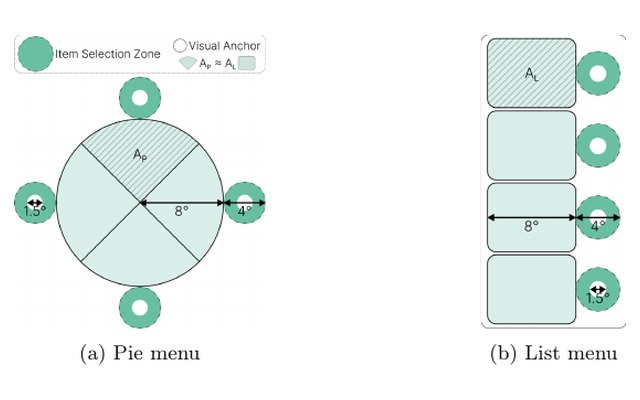
Gaze-Based Menu Navigation in Virtual Reality: A Comparative Study of Layouts and Interaction Techniques
A study with 19 participants that compares pie and list menus under dwell, controller and combined gaze-and-controller input: the pie layout was faster and less error-prone, while novice users tended to favour lists.
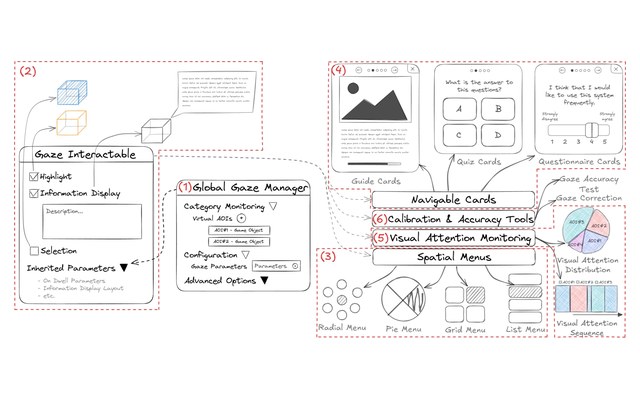
GTK: A Gaze-Based Interaction Toolkit in XR
A reusable Unity toolkit with gaze interactables, spatial context menus, onboarding, attention monitoring and accuracy checks.
DOI PDF (accepted version) Abstract Code Video Teaser Demo paper
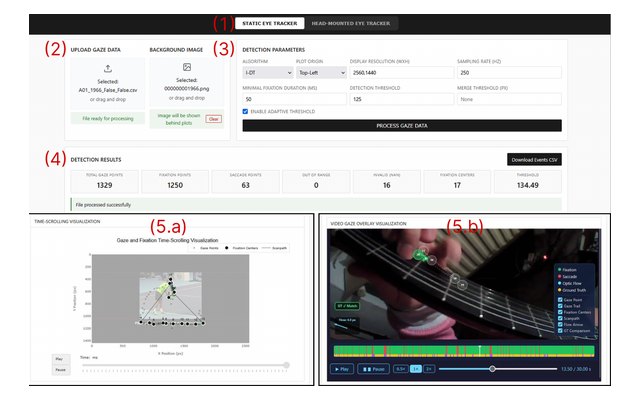
OpenGazeLab: An Interactive Toolkit for Gaze Analysis and Event Detection
A browser-based toolkit for detecting fixations and saccades in data from stationary and head-mounted eye trackers, with a timeline view for checking the results.
Explaining and correcting models
Interfaces that show what a model bases its output on and let the people who use it correct it, so that the model learns from them.
I-MPN: Inductive Message Passing Network for Efficient Human-in-the-Loop Annotation of Mobile Eye Tracking Data
A human-in-the-loop method for recognising objects in mobile eye-tracking recordings, which combines an object detector with a message passing network that takes the spatial relations between objects into account.
ConceptLens: Interactive Concept Bottlenecks for Black-Box Models
A model-agnostic interface for probing pre-trained classifiers through semantic concepts: local fidelity checks, what-if analysis, counterfactual search and refinement of the concept probes by the user.
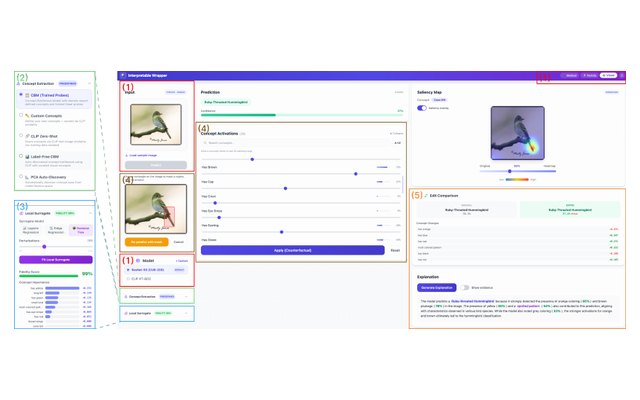
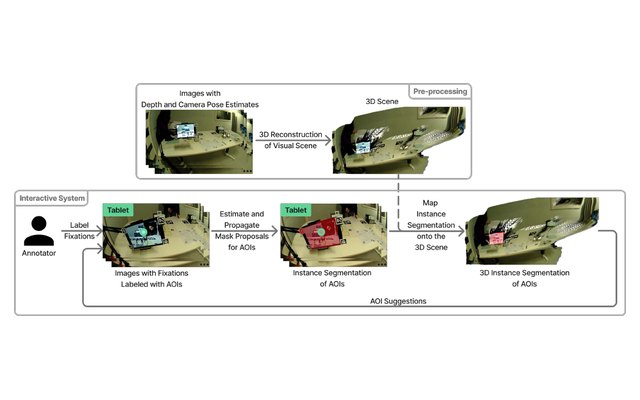
IMETA: An Interactive Mobile Eye Tracking Annotation Method for Semi-Automatic Fixation-to-AOI Mapping
A semi-automatic method for mapping fixations to areas of interest in mobile eye-tracking recordings, based on interactive video object segmentation and a 3D reconstruction of the scene.
AI in sports
Sports as the first real-world setting for both directions: interactive machine learning with multimodal sensing in AR and VR for athletes, coaches and guides, in skiing, table tennis and bouldering.
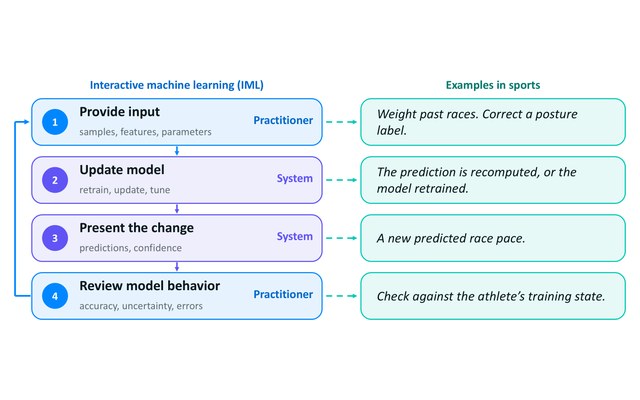
Why Sports Needs Interactive Machine Learning
An essay arguing that machine learning delivers little in sports while practitioners lack control over the models, and proposing interactive machine learning as the remedy.
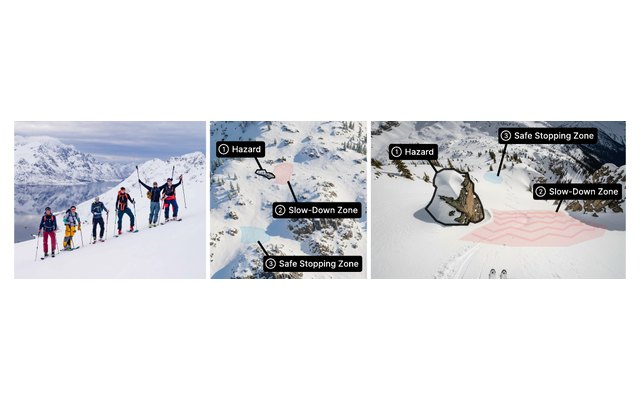
Heads Up!: Towards In Situ Photogrammetry Annotations and Augmented Reality Visualizations for Guided Backcountry Skiing
Tools with which a backcountry guide annotates a photogrammetry map of a mountainside with hazards and safe zones, which the skiers then see as overlays in an augmented reality heads-up display.
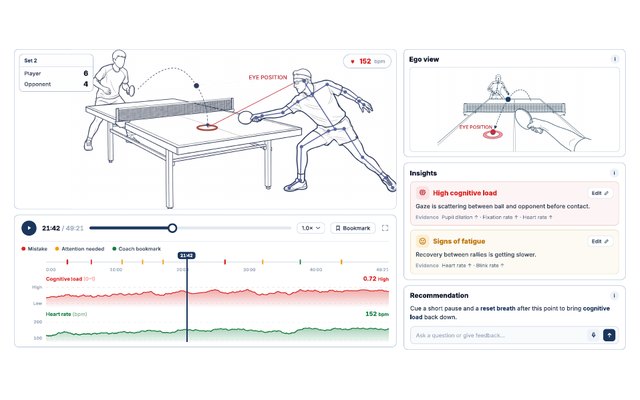
Understanding and Designing a Gaze-Based Interface for Table Tennis
Interviews with a coach and three table tennis players, and from them EyeCoach, a concept for a coach-facing interface that gives personalised training feedback from gaze and other signals.
XR for industrial training
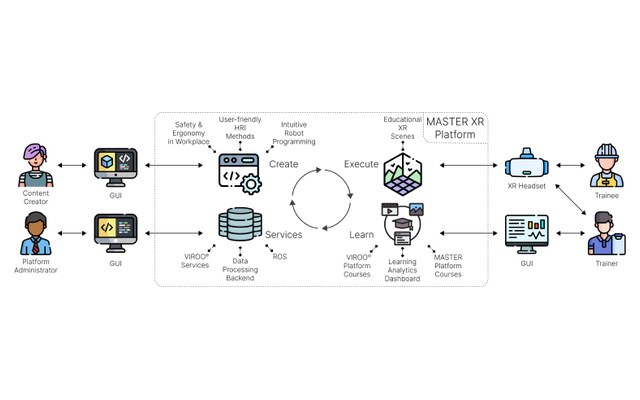
XR for teaching robotics in manufacturing, developed in the MASTER project.
The MASTER XR Platform for Robotics Training in Manufacturing
An overview of the open XR platform of the MASTER project, with modules for safe workspaces, robot programming and human-robot interaction, including eye tracking.
Computer vision
My doctoral work: segmentation and tracking of highly similar animals, and 3D semantic maps shared between humans and robots.
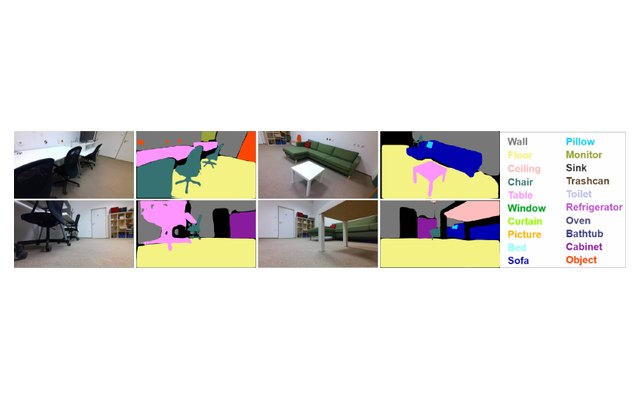
Cross-Viewpoint Semantic Mapping: Integrating Human and Robot Perspectives for Improved 3D Semantic Reconstruction
An extension of a real-time 3D semantic reconstruction pipeline that matches semantic labels between the viewpoint of a human and that of a small robot.
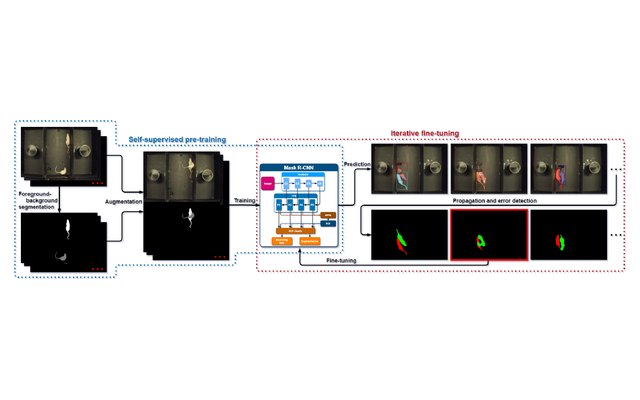
RATS: Robust Automated Tracking and Segmentation of Similar Instances
A deep learning approach for segmenting and tracking laboratory animals of identical appearance, which marks the frames where it is unreliable so that a human can annotate them.
Work in progress
Running studies and prototypes that are not published yet.
Understanding user intent for mixed-initiative authoring in VR
A VR authoring system in which a language-model agent builds the behaviour of a scene from spoken requests and first shows a preview of what it understood. We study how gaze, head and face signals indicate whether the user has looked at the preview and whether they doubt it, so that the agent asks or offers an alternative when the user seems unsure, and does not take silence as agreement.
Appropriate reliance on explainable AI in education
A field study in a university course for future teachers. The students judge a claim on their own, then see the judgement of an AI system, which is sometimes deliberately wrong, and can open explanations or ask a chatbot before they decide. The study examines which explanations help them tell when to follow the system and when to overrule it.
SetPiece: authoring immersive scenes together with LLM agents
A desktop and VR authoring system in which LLM agents build interactive 3D scenes and show their work as layout plans and behaviour graphs, which users inspect and edit by hand.
Collaboration
I am looking for partners for joint research projects, in particular companies that want to bring a use case from manufacturing, healthcare, robotics or sports into a European or international proposal. I am also glad to hear from research groups and sports organisations, and to show ongoing work in a call: [email protected].
- Topics
- Interactive machine learning, explainable and trustworthy AI, multimodal and gaze-based interaction, XR and user modelling. AI in sports across disciplines, with skiing as a central testbed. Industrial training, healthcare and robotics.
- Demonstrators and tools
- GTK: gaze interaction toolkit for Unity
- OpenGazeLab: gaze analysis toolkit for stationary and head-mounted eye trackers
- PhotoGraph: claim-centric knowledge graphs for personal photo management
- ConceptLens: interactive explainable AI wrapper for black-box models
- Heads Up!: drone photogrammetry and hazard annotation tool for guided backcountry skiing
- SetPiece: VR and desktop authoring tool with humanoid simulation
- Formats
- Joint proposals for publicly funded research projects, European or national, up to demonstrators that are tested in a realistic setting (TRL 6): a company brings the use case and its users, and we bring the methods and prototypes. Research networks, joint studies, co-supervised theses and research visits.
News
- Best Demo Award at SportsHCI 2026 for Heads Up!, our demo on augmented reality annotations for guided backcountry skiing.
- Three contributions at SportsHCI 2026 in Saarbrücken: the full paper Why Sports Needs Interactive Machine Learning and the demo Heads Up!, both of which I presented, and the poster on EyeCoach, a gaze-based interface for table tennis, presented by Abdulrahman Mohamed Selim.
- A demo at ICMI 2026 in Naples: ConceptLens, an interface for probing black-box models through semantic concepts (IML news).
- Final review meeting of MASTER at the University of Patras on 16 September: we presented the results of the project to the EU reviewers and demonstrated the educational scenarios we developed (post by MASTER).
- Erwin Wu from the Institute of Science Tokyo visited us in Saarbrücken. We discussed collaboration opportunities, Erwin gave an invited talk on his work in the Koike Lab, and we had a demo session in which we showed five recent systems: ConceptLens, EyeCoach, GazeDrift, Heads Up! and PhotoGraph.
- Best Paper Award at the GenAIK-NORA workshop at IJCAI-ECAI 2026 in Bremen for PhotoGraph, our paper on knowledge graphs for personal photo collections, presented by Omair Shahzad Bhatti (IML news).
- XR Education Day of XRISE at Saarland University on 17 July: Arham Ahmed presented our VR serious game GazeDrift.
- Two papers at ETRA 2026 in Marrakech: the gaze analysis toolkit OpenGazeLab and the authentication method EyeGestureLogin, both presented by Omair Shahzad Bhatti.
- Final event of MASTER at CORE in Oldenburg on 9 June, at the end of three and a half years: we had a demo session with the open-call projects in the CoreIML showroom (IML news, report by MASTER).
- Elif Polat Hopcan and Sinan Hopcan, associate professors in educational technology at Istanbul University-Cerrahpaşa, visited our lab in Saarbrücken. We discussed their work on human-centred and explainable AI in education and opportunities for collaboration.
- Three demos and a workshop paper at IEEE VR 2026 in Daegu, all of which I presented, among them the gaze interaction toolkit GTK and the serious game GazeDrift (IML news). There I also met members of the MASTER open-call projects REACH and VIRAMM from TH Köln (post by MASTER).
- EE Times reports on the eye-tracking tools we built for the MASTER XR platform.
- XRISE lecture at Saarland University on 18 December: Michael Barz and Maria Madarieta Elordi spoke about XR for robotics training in MASTER, and I gave the live demos of our eye-tracking module for the MASTER XR platform.
- I received my PhD degree from Eötvös Loránd University (ELTE) in Budapest.
- A full paper at INTERACT 2025 in Belo Horizonte: a comparison of layouts and interaction techniques for gaze-based menu navigation in VR.
- I defended my PhD thesis at Eötvös Loránd University (ELTE) in Budapest (IML news).
- Hannover Messe 2025: I presented the MASTER project at the DFKI stand (IML news).
- A demo at IUI 2025 in Cagliari: a tool for creating photobooks together with an AI in VR (IML news).
- Second industry symposium of IML and the University of Oldenburg: I presented my doctoral work and the MASTER project (IML news).
- Two posters and a demo at SUI 2024 and VRST 2024 in Trier, all of which I presented: the posters on gaze-based menu navigation and the MASTER XR platform, and the demo of the authentication method GazeLock (IML news).
- General Assembly of MASTER in Saarbrücken, hosted by DFKI (IML news).
Projects
- Current
AI in Sports AI in Skiing
We develop AI assistance for sports that the people who use it can inspect and correct. Our applications combine predictive machine learning models with multimodal sensing, such as eye tracking, wearables and drones, and deliver their assistance in augmented or virtual reality. Experts such as mountain guides and coaches see the reasoning behind a suggestion and can correct it, and through interactive machine learning the models learn from these corrections. In skiing, we develop tools that support backcountry guides in assessing hazards and in communicating safety information to the skiers they lead, and we study how alpine slalom athletes allocate their visual attention during the course inspection and the race, in collaboration with the Institute of Science Tokyo; the aim is visual guidance for athletes and coaching advice that coaches can inspect and adjust. We develop and test the components first in sports that are played in small, controlled spaces: in table tennis we are developing a tool that helps coaches and players reflect on play, based on gaze, pupil, heart rate and body pose, and in bouldering we are working on automatic proficiency estimation. VR is the testbed in which we build prototypes before they move outdoors.
- 2023 – 2026
MASTER: Mixed Reality Ecosystem for Teaching Robotics in Manufacturing
MASTER built a low-code XR platform for teaching and training robotics in manufacturing. The platform combines safe robotic environments, codeless robot programming and gaze-based interaction in one pipeline for authoring and running training scenarios (project video). The project had seven partners from three countries and a total budget of EUR 8.3 million, of which EUR 4.8 million went to two open calls. The calls funded 41 further projects, which added hardware, XR technologies and educational content to the platform. I mentored twelve of them: REACH, WAVE, XR4Human and XR4MCR in the first call, and AI-XRobo, AIXRIG, ARCHIVE, EMPAIRED, ICETeachXR, SkillXR, VIRAMM and XR-GRIT in the second. DFKI contributed gaze-based interaction and interactive machine learning, and published 19 papers in the project (list on Zenodo).
- 2023 – 2026
No-IDLE: Interactive Deep Learning Enterprise
No-IDLE studied interactive deep learning: deep learning models that learn from the people who use them, for example by talking with them in natural language and by observing them. Four groups of the department worked on it from the perspectives of human-computer interaction, machine learning, natural language processing and multimodal interaction, with one shared application, the interactive creation of photo books. The project was completed in 2026. I contributed to two of its results: a VR demo in which a user and an AI create a photo book together, and PhotoGraph, a knowledge graph for personal photo collections.
- 2022
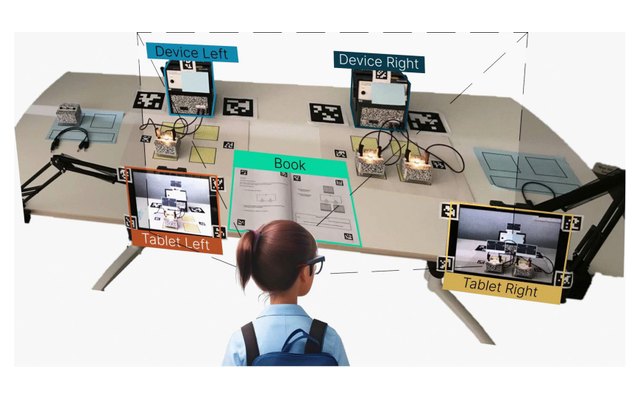
GeAR: Augmented Reality in Experimental Teaching and Learning Scenarios
GeAR studied learning with augmented reality at school: where AR helps pupils in experiments, and what it demands of them. It was a joint project of Saarland University, the Kaiserslautern University of Technology and DFKI. I worked on semi-automatic annotation tools for mobile eye-tracking data, such as IMETA and I-MPN.
In the press
- EE Times
- XR Brings Humans and Robots Closer on the Factory Floor, 2026
- VR Today Magazine
- Eyes as Passwords: German Researchers Pioneer Gaze-Based Security for XR Headsets, 2025
Teaching
- 2019 – 2022
Applied Deep Learning, lecture and practice for MSc students, ELTE. Lecturer.
I developed the course material and gave the lectures, which were shared with the courses Advanced Machine Learning and Artificial Neural Networks. The lectures went from linear regression and the multilayer perceptron through the training of neural networks to convolutional and recurrent networks, autoencoders and GANs, with an outlook on object detection, segmentation, and speech and text processing. In the practice sessions, the students solved two small deep learning projects in Python notebooks and could present a recent paper together with its code.
- 2019
Software for the Application of Deep Neural Networks, practice (seminar) for BSc students, ELTE. Instructor.
I developed the course material and held the sessions: a practice-oriented introduction to Keras and TensorFlow in Python, with little theory.
- 2017 – 2018
Design of Distributed Systems, tutorial for BSc and MSc students, ELTE. Teaching assistant.
I held the consultations that accompany the lecture and the practice, and designed and graded the programming exercises in which the students apply the methods. The course covers the formal specification of distributed programs, their safety and progress properties and the verification of these, the composition of programs from components with proven properties, and communication over message channels.
- 2017
Event-Driven Programming I, practice for BSc students, ELTE. Teaching assistant.
I held practice sessions. Building on object-oriented programming, the students develop event-driven applications with graphical user interfaces in C++ and Qt, from single-window programs to multi-layer applications that work with a database.
Supervision
- Guide
- Students who are looking for a thesis topic, please see Writing a thesis at IML.
- Ongoing
Muhammad Abu Ahmad (University of Oldenburg, MSc): The Live PM Form: An Interface for Integrating Expert Backcountry Ski Guides' Judgment into a Machine Learning Model
The thesis develops an interface with which backcountry ski guides correct a model's hazard estimates for the terrain and give their reasons, so that later estimates take their judgment into account.
- Ongoing
Arham Ahmed (Saarland University, MSc): Stretching Time in Impossible Spaces: Altering Exercise Time Perception in VR Through Non-Euclidean Architecture and Adaptive Gameplay
The thesis builds a VR exergame for a play area of 2.5 by 2.5 metres, in which portals and corridors connect five body-tracked exercises, and plans a study on whether such a space changes how long the exercise feels.
- Ongoing
Hafiz Aqib Ahmed (Saarland University, MSc): Multimodal Crux Localisation and Crux-Aware Proficiency Estimation in Bouldering
The thesis aims to locate the crux, the hardest section of a boulder problem, in multimodal recordings of climbers and to use it for estimating their proficiency.
- Ongoing
Saleem Ahmad (University of Bremen, MSc): Design and Usability Evaluation of a Virtual Reality Interface for Audio Data Annotation in Active Learning Workflows; co-author of our IEEE VR 2026 demo
The thesis develops a VR application in which machine learning experts explore and annotate audio samples in an embedding space that changes as the model is updated.
- 2024
Albert Klimenko (Saarland University, BSc): Comparative Analysis of Multi-Level Gaze-Based Menus: Exploring Pie vs. List Layouts and Interaction Modalities in Augmented and Virtual Reality; co-author of our INTERACT 2025 paper
The thesis implemented six gaze-based menus, with a controller-based menu for comparison, and compared hierarchical list and pie layouts in a user study with 19 participants.
- 2021
Ahmad Taan (ELTE, MSc): Automated Behavioral Analysis of Laboratory Rodents Based on Deep Learning and Computer Vision; second prize at the Conference of Scientific Students' Associations (TDK), presented at the national conference (OTDK 2023) in the computer vision section
The thesis presented software that segments and tracks two interacting rodents in video, detects their tails and keypoints, and identifies their social behaviours with rules that a domain expert defined.
- 2020
Kevin Attila Hartyányi (ELTE, BSc): Monocular Speed Estimation
The thesis presented a program that estimates the speed of a car from the video of a single camera, using optical flow and depth estimation.
- 2020
Szilvia Szeier (ELTE, BSc): Monocular Speed Estimation without Semantic Information; co-author of our Sensors paper
The thesis presented a program that estimates the speed of a car from the video of a single camera without relying on semantic information about the scene.
- 2020
Kevin Attila Hartyányi and Szilvia Szeier (ELTE): Combining Deep Neural Networks for Speed Estimation; third prize at the Conference of Scientific Students' Associations (TDK)
The paper estimated driving speed on plain RGB videos of the KITTI dataset by combining networks for motion estimation and single-view depth prediction.
- 2020
András Csertán (ELTE): Artificial Neural Networks, project in the New National Excellence Program (ÚNKP 2019/20)
The project was a one-year study of the mathematical foundations of machine learning and deep neural networks, in theory and in programming exercises.
Awards
- 2026
- Best Demo Award, SportsHCI 2026, for Heads Up!, with C. A. Johns, M. Barz and D. Sonntag
- 2026
- Best Paper Award, GenAIK-NORA Workshop at IJCAI-ECAI 2026, for PhotoGraph, with O. S. Bhatti, A. Mohamed Selim, M. Barz and D. Sonntag
- 2018
- Excellent Student of the Faculty, ELTE Faculty of Informatics
- 2018
- First prize, Conference of Scientific Students' Associations (TDK), ELTE, informatics section
- 2017
- Second prize, Conference of Scientific Students' Associations (TDK), ELTE, informatics section